What is Anomaly Detection? A Complete Guide for Beginners

When your bank blocks a suspicious transaction you didn't make, when a factory's AI predicts machine failure before it happens, or when a security system detects someone using a printed photo instead of their real face — that's Anomaly Detection at work. It's the AI technology that finds the needle in the haystack, the one unusual pattern among millions of normal ones.
What is Anomaly Detection?
Anomaly Detection (also called Outlier Detection) is an AI technique that identifies data points, events, or patterns that deviate significantly from the expected norm. It's like having an intelligent watchdog that knows what "normal" looks like and immediately alerts you when something unusual happens.
At its core, anomaly detection:
- Learns what normal behavior looks like from historical data
- Monitors incoming data in real-time or batch processing
- Identifies deviations that could indicate problems, fraud, or opportunities
- Alerts when unusual patterns are detected
Simple Analogy
Imagine you're a security guard watching hundreds of people enter a building:
- Manual approach: You try to remember every person and spot anything unusual (impossible at scale)
- Anomaly detection: AI learns the normal entry patterns (timing, frequency, behavior) and instantly flags when someone enters at 3 AM, uses an unusual badge pattern, or behaves differently
The AI doesn't need to know every specific threat — it just needs to recognize when something doesn't fit the established pattern of "normal."
How Anomaly Detection Works
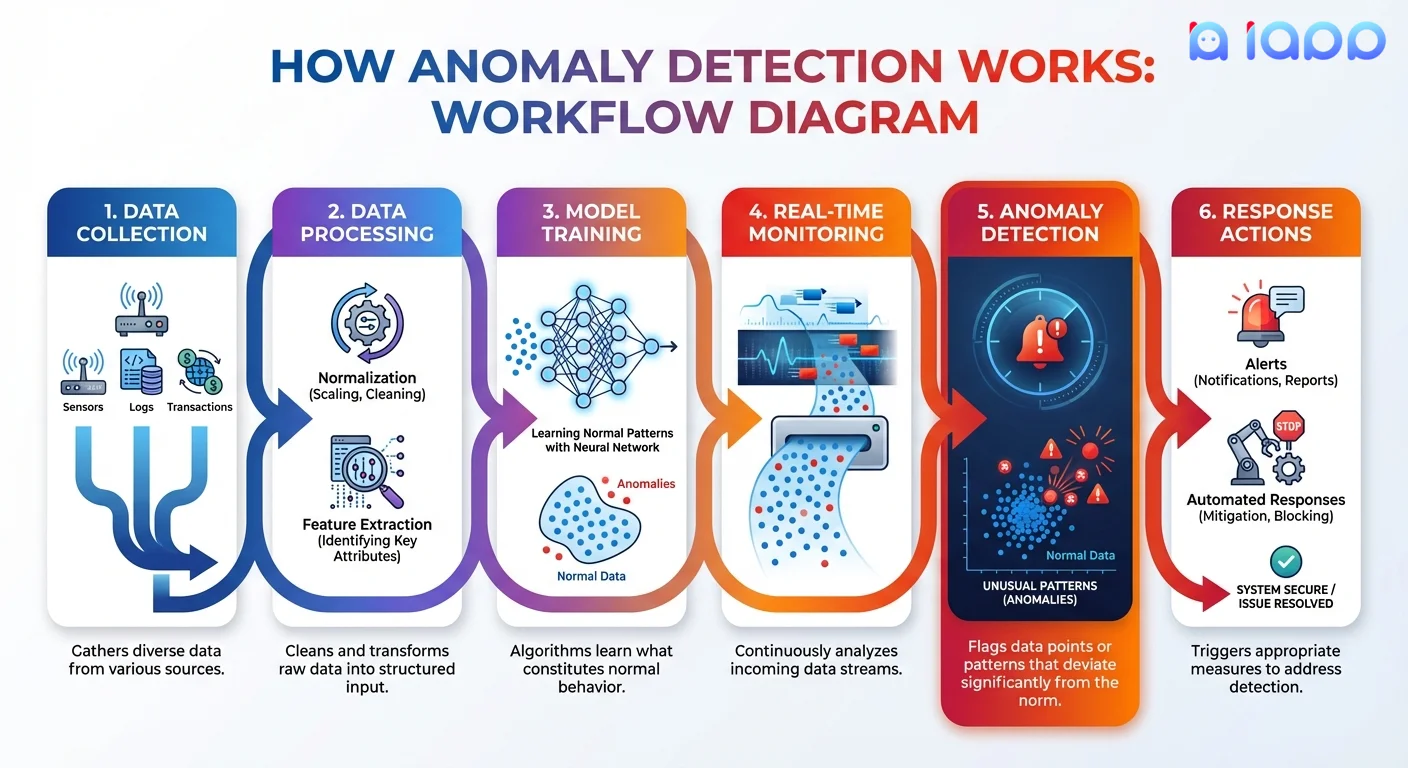
The Process Step-by-Step
1. Data Collection
- Gather historical data representing normal behavior
- Sources: transaction logs, sensor readings, network traffic, user behavior
- The more data, the better the model understands "normal"
2. Data Preprocessing
- Clean and normalize the data
- Handle missing values and outliers in training data
- Extract relevant features for analysis
3. Model Training
- Algorithm learns the patterns of normal behavior
- Creates a mathematical representation of "normal"
- Different algorithms suit different data types
4. Real-time Monitoring
- New data is continuously fed to the model
- Each data point is compared against learned patterns
- Model calculates how "abnormal" each observation is
5. Anomaly Scoring
- Each data point receives an anomaly score
- Higher scores indicate greater deviation from normal
- Threshold determines what triggers an alert
6. Response & Action
- Alerts sent to relevant teams or systems
- Automated responses can be triggered
- Human review for critical decisions
Types of Anomalies
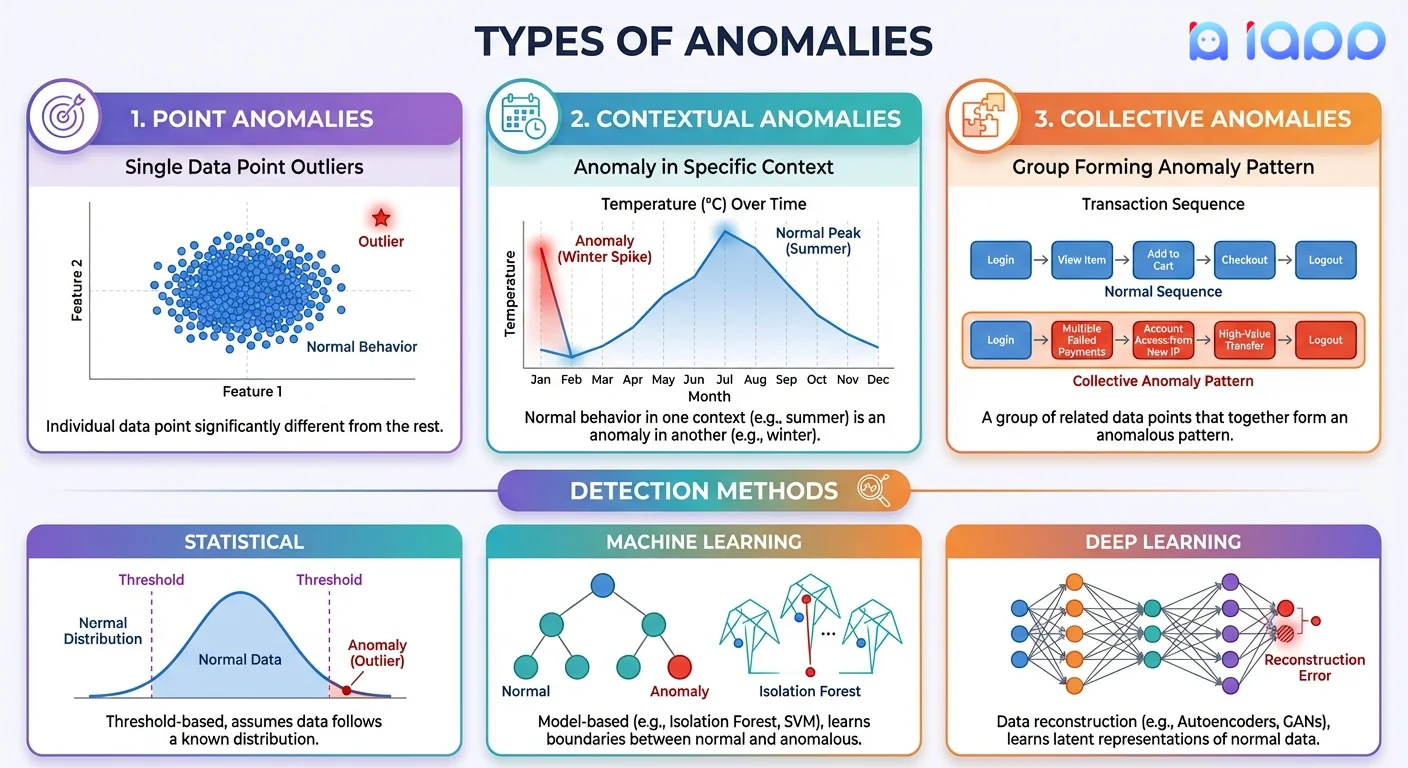
1. Point Anomalies
What it is: A single data point that is significantly different from the rest of the data.
Example:
- A credit card transaction of ฿500,000 when the customer's average is ฿5,000
- A temperature reading of 150°C in a room that's normally 25°C
- A user logging in from Thailand when they've only ever logged in from Japan
Best detected by: Statistical methods, Isolation Forest, One-Class SVM
2. Contextual Anomalies
What it is: A data point that is anomalous only in a specific context, but normal in others.
Example:
- High electricity usage is normal at 7 PM (dinner time) but anomalous at 3 AM
- A 20% sales increase is normal during Songkran but unusual in regular months
- A spike in network traffic is expected during business hours but suspicious at midnight
Best detected by: Time-series analysis, LSTM neural networks, seasonal decomposition
3. Collective Anomalies
What it is: A group of data points that together form an anomalous pattern, even though individual points may seem normal.
Example:
- A sequence of small transactions that together indicate money laundering
- A pattern of failed login attempts across multiple accounts (coordinated attack)
- Gradual sensor drift that indicates equipment degradation over time
Best detected by: Sequence models, recurrent neural networks, pattern mining
Types of Anomaly Detection Methods
1. Statistical Methods
How it works: Assumes data follows a statistical distribution; points outside expected range are anomalies.
Key techniques:
- Z-Score: Measures how many standard deviations a point is from the mean
- IQR (Interquartile Range): Flags points outside Q1-1.5×IQR to Q3+1.5×IQR
- Grubbs' Test: Tests if the most extreme value is an outlier
Pros: Fast, interpretable, no training needed Cons: Assumes normal distribution, struggles with complex patterns
2. Machine Learning Methods
How it works: Algorithms learn normal patterns from data and flag deviations.
Key techniques:
- Isolation Forest: Isolates anomalies by random partitioning (anomalies are easier to isolate)
- Local Outlier Factor (LOF): Measures local density deviation; points in low-density areas are anomalies
- One-Class SVM: Learns a boundary around normal data; points outside are anomalies
- K-Means Clustering: Points far from cluster centers are anomalies
Pros: Handles complex patterns, works with high-dimensional data Cons: Requires training data, may need tuning
3. Deep Learning Methods
How it works: Neural networks learn complex representations of normal data.
Key techniques:
- Autoencoders: Learn to compress and reconstruct normal data; high reconstruction error = anomaly
- Variational Autoencoders (VAE): Probabilistic autoencoders with uncertainty estimation
- LSTM Networks: Capture temporal patterns in sequence data
- CNN for Images: Detect visual anomalies in images (face spoofing, defect detection)
Pros: Handles very complex patterns, works with images/video/sequences Cons: Requires more data, computationally expensive, less interpretable
Key Terms Explained (Jargon Buster)
1. False Positive vs False Negative
False Positive (Type I Error): The system flags something as an anomaly when it's actually normal.
- Example: Your bank blocks a legitimate purchase because it "looked suspicious"
- Impact: Annoyance, wasted investigation time, customer frustration
False Negative (Type II Error): The system misses an actual anomaly, classifying it as normal.
- Example: A fraudulent transaction goes undetected
- Impact: Security breach, financial loss, undetected problems
Trade-off: Reducing false positives usually increases false negatives, and vice versa. The right balance depends on the cost of each type of error.
2. Threshold
What it is: The boundary that separates "normal" from "anomaly" based on the anomaly score.
Simple explanation: Think of it as the sensitivity dial. A lower threshold catches more anomalies (but also more false positives). A higher threshold misses some anomalies (fewer false positives, more false negatives).
Example:
- Anomaly score > 0.9: Very strict, only flags obvious anomalies
- Anomaly score > 0.5: Moderate, flags questionable cases
- Anomaly score > 0.3: Sensitive, flags anything slightly unusual
3. Reconstruction Error
What it is: In autoencoder-based detection, it's the difference between input data and the model's attempt to reconstruct it.
Simple explanation: The model learns to compress and decompress normal data. When it sees an anomaly it hasn't learned, it reconstructs it poorly. The bigger the difference (error), the more likely it's an anomaly.
Example: An autoencoder trained on real faces struggles to reconstruct a printed photo or mask, resulting in high reconstruction error → detected as face spoofing.
4. Anomaly Score
What it is: A numerical value indicating how likely a data point is to be an anomaly (usually 0-1 or unbounded).
Simple explanation: The "weirdness score" of a data point. Higher scores mean more unusual. The exact interpretation depends on the algorithm.
Example:
- Score 0.1: Very normal, nothing to worry about
- Score 0.5: Somewhat unusual, worth monitoring
- Score 0.95: Highly anomalous, investigate immediately
5. Baseline / Normal Profile
What it is: The learned representation of what "normal" looks like for a system.
Simple explanation: Before detecting anomalies, the system must first understand what normal is. This baseline is built from historical data of normal operations.
Why it matters: A poorly defined baseline leads to poor detection. If the training data contains anomalies, the model might consider them normal.
Why Anomaly Detection is Important
1. Fraud Prevention
Problem: Financial fraud costs businesses billions annually Solution: Detect suspicious transactions in real-time
Real impact:
- Block fraudulent credit card transactions before completion
- Detect account takeover attempts
- Identify money laundering patterns
2. Cybersecurity
Problem: Cyber attacks evolve faster than rule-based systems can adapt Solution: AI detects unusual network behavior without predefined rules
Real impact:
- Detect zero-day attacks by behavior, not signatures
- Identify insider threats
- Spot data exfiltration attempts
3. Predictive Maintenance
Problem: Equipment failures cause costly downtime Solution: Detect early warning signs in sensor data
Real impact:
- Predict machine failures days in advance
- Reduce unplanned downtime by 30-50%
- Optimize maintenance schedules
4. Identity Verification
Problem: Fraudsters use fake photos, masks, and videos to bypass biometric systems Solution: Face liveness detection identifies spoofing attempts
Real impact:
- Detect printed photos, masks, and screen replays
- Secure eKYC and banking applications
- Achieve 99%+ accuracy in spoofing detection
5. Quality Control
Problem: Manual inspection can't catch all defects Solution: AI detects visual anomalies in products
Real impact:
- Automatic defect detection in manufacturing
- Consistent quality across all products
- Reduced human inspection costs
What Problems Does Anomaly Detection Solve?
| Industry | Problem | Anomaly Detection Solution |
|---|---|---|
| Banking | Credit card fraud | Real-time transaction monitoring |
| Insurance | Fraudulent claims | Pattern detection in claim data |
| Healthcare | Medical fraud | Unusual billing pattern detection |
| Manufacturing | Equipment failure | Sensor anomaly monitoring |
| Retail | Inventory shrinkage | Unusual sales/inventory patterns |
| Telecom | Network intrusions | Traffic anomaly detection |
| eKYC | Identity spoofing | Face liveness detection |
Anomaly Detection in Thailand: Real Applications
1. Banking & Financial Services
Use case: Thai banks detecting fraudulent transactions
How it works:
- Monitor millions of transactions daily
- Learn normal spending patterns per customer
- Flag unusual amounts, locations, or timing
- Block suspicious transactions in real-time
Thai-specific challenges solved:
- Detecting fraud during high-volume periods (Songkran, year-end)
- Understanding Thai spending patterns
- Protecting mobile banking users
2. eKYC & Face Spoofing Detection
Use case: Preventing identity fraud in digital onboarding
How it works:
- Detect if face image is from a real person or spoofing attempt
- Identify printed photos, masks, screen displays, video replays
- Score each verification attempt for liveness
Example with iApp API:
import requests

# Detect face spoofing attempt
with open('face_image.jpg', 'rb') as f:
    response = requests.post(
        'https://api.iapp.co.th/v3/store/ekyc/face-passive-liveness',
        headers={'apikey': 'YOUR_API_KEY'},
        files={'file': f}
    )

result = response.json()
# Output: {"predict": "REAL", "score": 0.9987, ...}
# Or: {"predict": "SPOOF", "score": 0.9999, ...}
iApp's Face Passive Liveness Detection is iBeta Level 1 certified, achieving 99.43% accuracy across 7,680 tests.
3. Content Moderation
Use case: Detecting toxic or inappropriate content on Thai platforms
How it works:
- Monitor user-generated content
- Classify text as toxic or non-toxic
- Flag anomalous content patterns (spam campaigns, coordinated attacks)
Example with iApp API:
import requests

# Detect toxic Thai content
response = requests.post(
    'https://api.iapp.co.th/v3/store/nlp/toxicity-classification',
    headers={'apikey': 'YOUR_API_KEY'},
    params={'text': 'ข้อความที่ต้องการตรวจสอบ'}
)

result = response.json()
# {"label": "toxic", "score": 0.89} or {"label": "non_toxic", "score": 0.92}
4. Manufacturing Quality Control
Use case: Thai factories detecting product defects
How it works:
- Cameras capture product images on production line
- AI compares against learned "normal" product appearance
- Flags visual anomalies (scratches, missing components, color variations)
5. Smart City & IoT
Use case: Monitoring infrastructure and utilities
How it works:
- Collect data from sensors (water meters, power meters, traffic)
- Detect unusual patterns indicating leaks, theft, or failures
- Enable predictive maintenance for city infrastructure
How to Use iApp Anomaly Detection APIs
iApp Technology provides production-ready anomaly detection APIs for various use cases.
Face Liveness Detection (Anti-Spoofing)
Detect if a face image is from a real person or a spoofing attempt.
curl -X POST 'https://api.iapp.co.th/v3/store/ekyc/face-passive-liveness' \
  -H 'apikey: YOUR_API_KEY' \
  -F 'file=@face_image.jpg'
Response:
{
    "predict": "SPOOF",
    "score": 0.9999,
    "data": {
        "SPOOF": 0.9999,
        "REAL": 0.0001
    }
}
Toxicity Detection
Detect anomalous/toxic content in Thai text.
curl -X POST 'https://api.iapp.co.th/v3/store/nlp/toxicity-classification' \
  -H 'apikey: YOUR_API_KEY' \
  -d 'text=ข้อความที่ต้องการตรวจสอบ'
Python Example: Face Spoofing Detection
import requests

def detect_spoofing(image_path, api_key):
    """Detect if face image is real or spoofed"""
    with open(image_path, 'rb') as f:
        response = requests.post(
            'https://api.iapp.co.th/v3/store/ekyc/face-passive-liveness',
            headers={'apikey': api_key},
            files={'file': f}
        )

    result = response.json()

    is_real = result['predict'] == 'REAL'
    confidence = result['score']

    print(f"Detection: {'Real Person' if is_real else 'Spoofing Attempt'}")
    print(f"Confidence: {confidence:.2%}")

    return result

# Usage
result = detect_spoofing('selfie.jpg', 'YOUR_API_KEY')
Getting Started with Anomaly Detection
For Business Users
- Identify your use case: What anomalies are you trying to detect? (Fraud, defects, intrusions, spoofing)
- Gather historical data: You need examples of normal behavior to train models
- Choose the right approach: Pre-built APIs (like iApp) or custom models
- Start with a pilot: Test on a subset before full deployment
- Monitor and tune: Adjust thresholds based on false positive/negative rates
For Developers
- Get API access: Sign up for free API key
- Read the docs: Face Liveness Detection, Toxicity Classification
- Test with sample data: Use the interactive demos
- Integrate: Add anomaly detection to your application
- Monitor performance: Track detection accuracy and adjust thresholds
Resources
- Face Spoofing Detection: Face Passive Liveness API
- Content Moderation: Toxicity Classification API
- Face Verification: Face Verification API
- Get API Key: API Key Management
- Join Community: Discord
The Future of Anomaly Detection
Trends to Watch in 2025
- Edge AI: Anomaly detection directly on devices (IoT sensors, cameras) for instant response
- Federated Learning: Train models across distributed data without centralizing sensitive information
- Explainable AI: Models that explain why something is flagged as anomalous
- Multimodal Detection: Combining text, image, audio, and behavioral signals
- Self-Adaptive Systems: Models that automatically update their baseline as normal patterns evolve
Why Thai Businesses Should Invest Now
- Growing digital economy: More digital transactions = more fraud opportunities
- Regulatory compliance: ธปท. and SEC require robust fraud detection
- Competitive advantage: Better security builds customer trust
- Cost reduction: Automated detection vs. manual review
- Real-time protection: Stop threats before damage occurs
Conclusion
Anomaly Detection is the AI technology that finds the unusual among the normal — the fraudulent transaction among millions of legitimate ones, the spoofed face among real verifications, the failing machine among healthy ones. By learning what "normal" looks like, these systems can identify threats, fraud, and problems that would be impossible to catch manually.
For Thai businesses, having robust anomaly detection is no longer optional. Whether you're protecting customer identities with Face Liveness Detection, moderating content with Toxicity Classification, or securing transactions, iApp Technology provides production-ready APIs built for Thai business needs.
Ready to detect anomalies in your business? Sign up for free and start protecting your systems today!
Questions? Join our Discord Community or email us at support@iapp.co.th.
iApp Technology Co., Ltd. Thailand's Leading AI Technology Company
Sources: